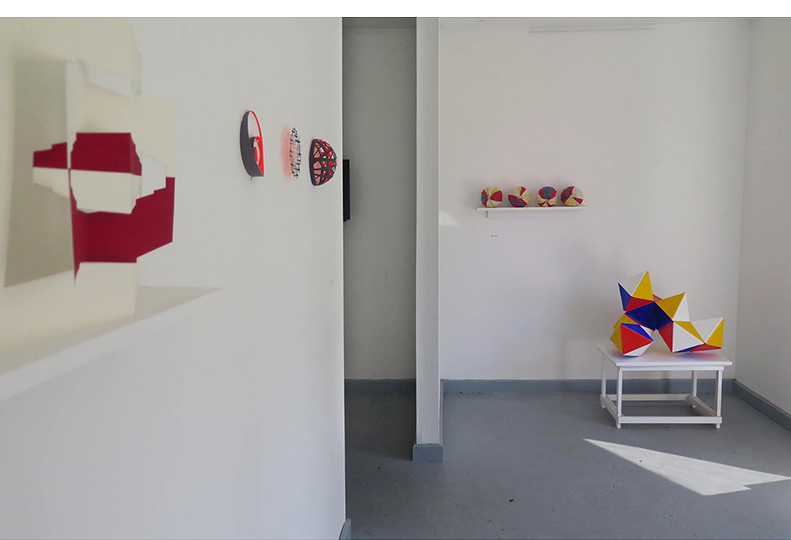
A group show “Logic & Structure: Part 2”; October 2017, The Painters Gallery, 1109 Main Street, Fleischmanns, NY. Artists: Beth Caspar, Susan Spencer Crowe, Joan Grubin, Robert James, Wanda Kossak, Don Muchow, Margaret Neill, Paula Quinon
With some difficulties, but at the end successfully, the participating artists responded to these concepts:
A structure: A structure has a domain that is a collection of elements. The elements can be points, lines, shapes, particular fragments of a larger whole, or anything in general. What makes the domain a structure is a choice of relations between its elements.
Binary relations: Relations involving pairs of objects are called binary. In an artwork there could be many natural choices for binary relations, such as larger, thinner, brighter, parallel, of similar shape, etc.
While elements and relations of two structures can be of different nature, the underlying abstract structure for both can be the same. Such structures are called isomorphic.
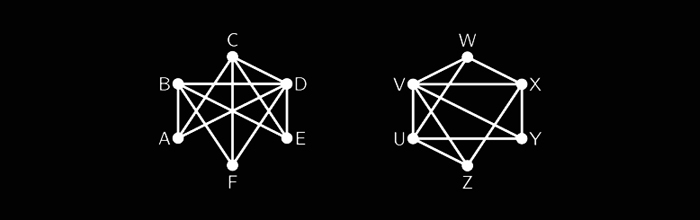
ISOMORPHIC GRAPHS
These graphs are isomorphic. The graph on the left
can be redrawn to look like the one on the right as follows:
A⟷W, E⟷Y, F⟷Z, B⟷U, C⟷X, D⟷V
Beth Caspar

Beth Caspar, edge: joined octahedrons, 2017, painted corrugated cardboard; edge: seamed segments of spheres, 2017, stitched rice paper, each 6 inches in diameter
Susan Spencer Crowe

Susan Spencer Crowe, Pentagon from a Circle 1, Pentagon from a Circle 2, 2017, cut and folded watercolor paper, graphite and Flashé, 11” high, 15” wide, depth variable
Joan Grubin

Joan Grubin, Three Circles, 2017, acrylic on paper, each 5 1/2” x 5 1/2”
#1: Open/Nested; #2: Woven; #3: Woven Dome
Robert James

Robert James, Untitled, 2017. Archival pigment print
Don Muchow
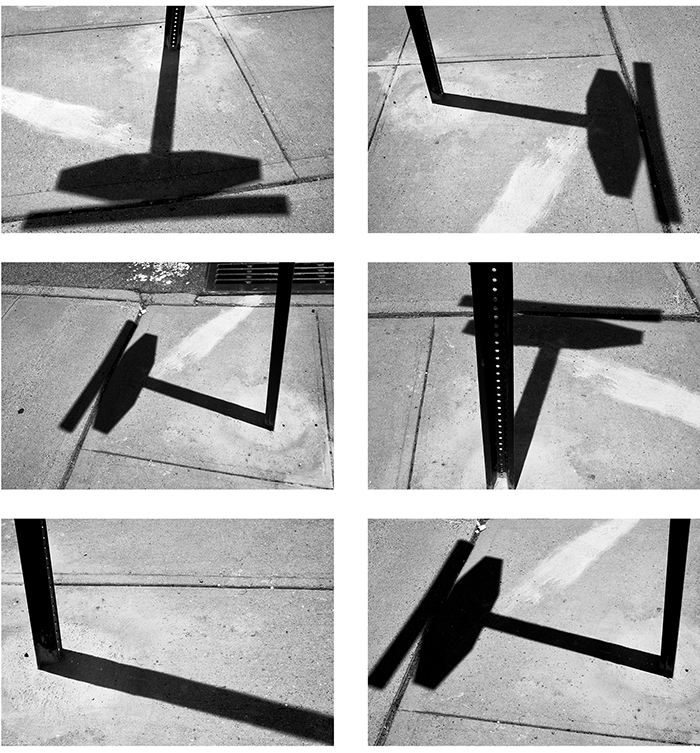
Don Muchow, Shadow Line #1 – #6, 2016. B&W archival pigment print, 7” x 10.25”
Margaret Neill

Margaret Neill, Root, 2017. Ink on paper mounted on panel, 4” x 12” x 1” diptych (top) Edge Relation, 2017. Watercolor on paper mounted on panel, 4″ x 12” x 1” diptych (bottom)
Wanda Siedlecka

Wanda Siedlecka, Regions of Sicily, 2017. An animation
Paula Quinon
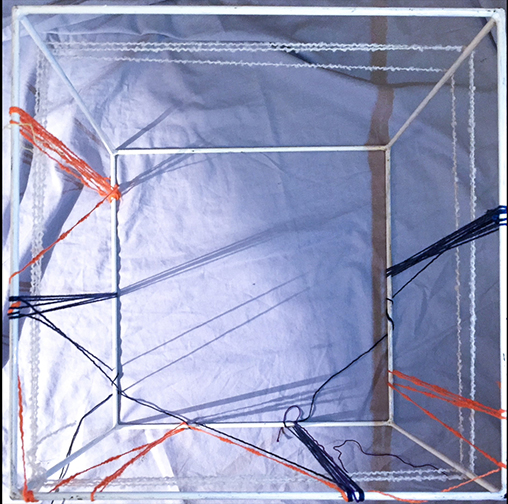
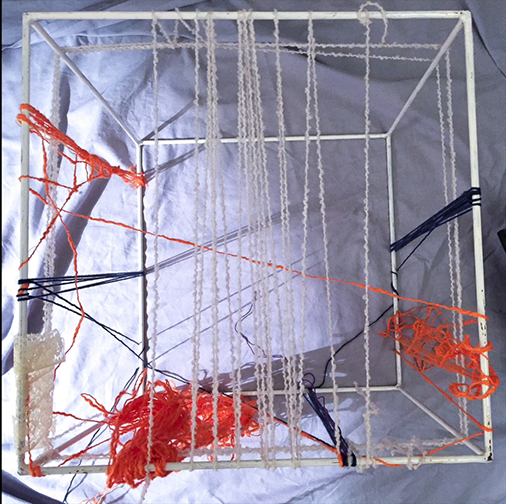
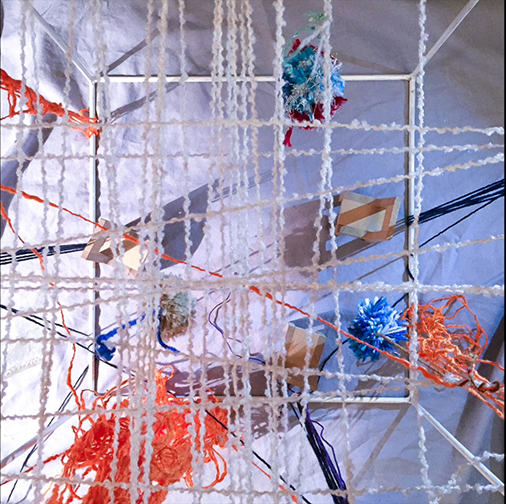
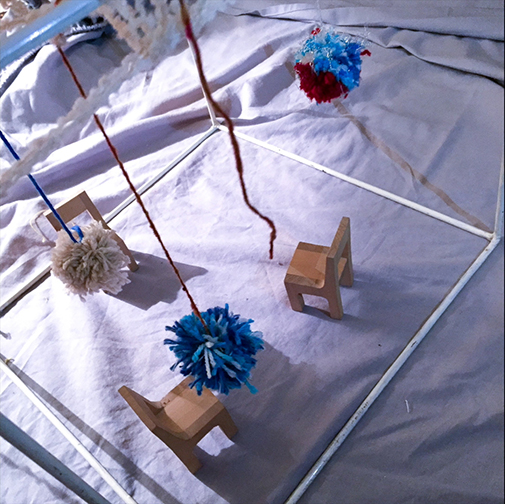
Paula Quinon and Luis Rosa, Possible Worlds for Aliens, 2017, video, multimedia
A series of isomorphic structures documented in a stop-motion animation shows how the same relational description refers to universes that a spectator observes as very different. The structure of sequences of sounds is isomorphic to structures documented on photographs. The project explores isomorphism in a cross-modal manner. All the universes are composed from three different types of objects (described by unary predicates) organized in such a way that relations (described by binary predicates) between elements are translatable between domains.
There are 3 objects of type 1, three elements of type 2 and one element of type 3. Four binary relations are described between types of elements. There are two relations between elements of type 1 and type 2. In intended interpretations they mean “being to the left” and “being to the right”. Relations that might be interpreted as “being above” and “being below” are defined between the elements of the type 1 and the element of the type 3, and between the elements of the type 2 and the element of the type 3.
The title “Possible Worlds for Aliens” expresses our interest in exploring non-intended possibilities of interpretation of predicates and intentional differences between similar structures. It is based on the idea, sometimes explored in philosophy, that mathematics of aliens would differ from our mathematics. The presented video is our first step towards a series of multimedia installations devoted to this topic.
 The Painters