The story of Ionel Talpazan and his path to citizenship
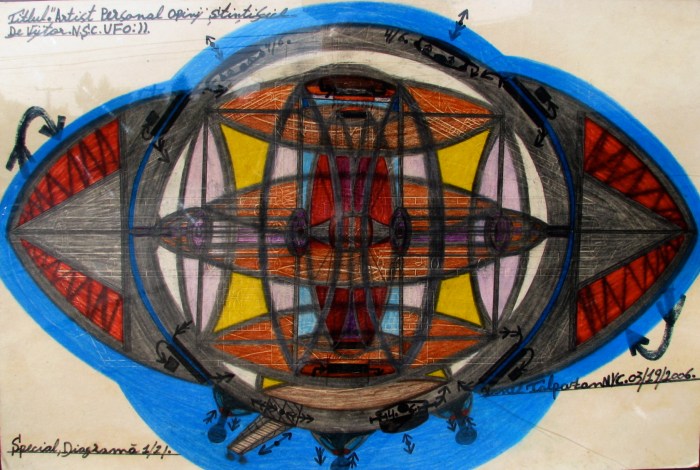
We all know that angels have wings
We all know that angels have wings but how do they grow out of their backs? What do they actually look like? These are questions that painters who believed in what the Gospel says must have asked themselves, so the way an angel stands or sits on a cloud had to be a subject of serious consideration. Investigations into the construction and appearance of flying saucers belong to the same tradition: these spaceships created by the higher beings, how do they fly?
Arrival
Ionel Talpazan, who late in life changed his name to Adrian da Vinci, fled communist Romania in 1986 and was admitted to the United States as a refugee, obtaining permanent resident status upon arrival. A prolific painter who sold his work on the street, he became known in New York art circles as the “UFO painter.” He loved America. He loved the American flag and the Statue of Liberty. A tiny place in Harlem where he lived and worked was decorated with all sorts of paraphernalia of American freedom and democracy.
He imagined
He imagined UFOs in myriads of shapes. He imagined their technological inner-workings and the trajectory of their travels leading far beyond our Solar System. He imagined endless galaxies populating the Universe, all different, always in flux, breathing, alive.
Out of his love for America, he imagined that he had the right to vote. He believed he would please the authorities by doing what the flyers left in his mailbox urged: “VOTE!” He could not have been more mistaken. A volunteer from a polling station in his neighborhood didn’t know any better.
Regardless of whether it stemmed from disinformation or malicious intent, the act he committed is punishable by deportation
In trouble
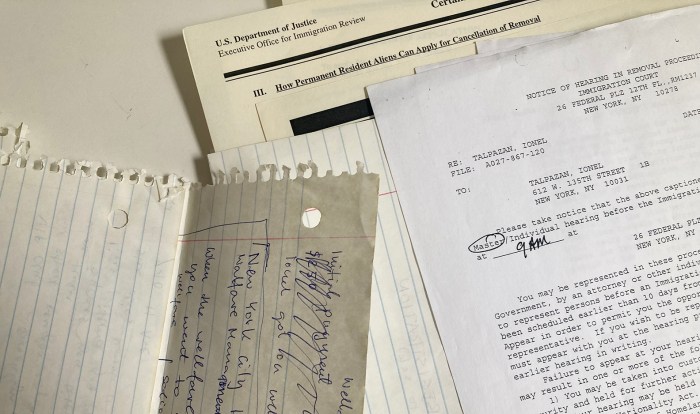
After he admitted to voting on his application for the American citizenship, the immigration machinery sprang into action, and very soon he received a notification that “removal proceedings” had been initiated against him. The matter was deadly serious. He was going to be deported. When it happened, he had already lived in New York for 22 years.
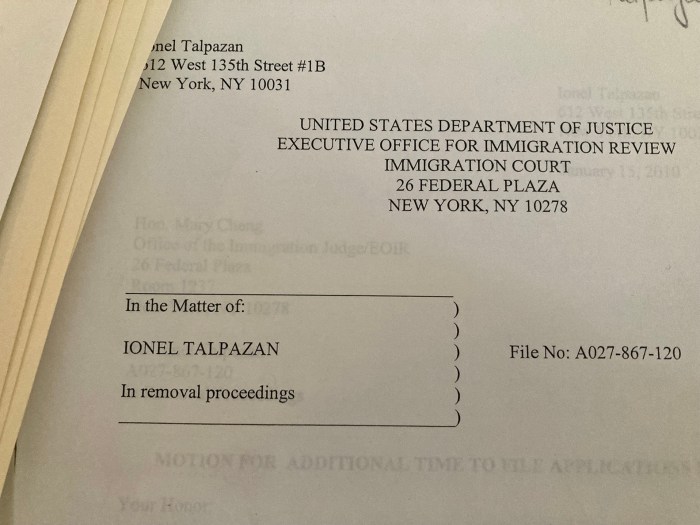
The only way out of the trouble was to appeal the decision by invoking the exception granted for individuals who could demonstrate that they had made a significant contribution to American society. The pro bono lawyers he contacted didn’t think they could prove it and, since Talpazan was stateless, urged him to choose the country to be deported to. He chose Italy.
Yes, indeed, he wasn’t a particularly impressive citizen—5’3″ tall, malnourished, with only a few front teeth left. The income reported on his tax returns over the years was consistently pitiful, as was the kind of jobs he held. He lived in public housing and collected welfare for a few years.

He looked and behaved like a street bum. And yet, he made a contribution to American society by imagining possibilities that had not occurred to others—by looking at the sky and then beyond it. His painting were exhibited by the best outsiders art galleries, and included in museums collections.
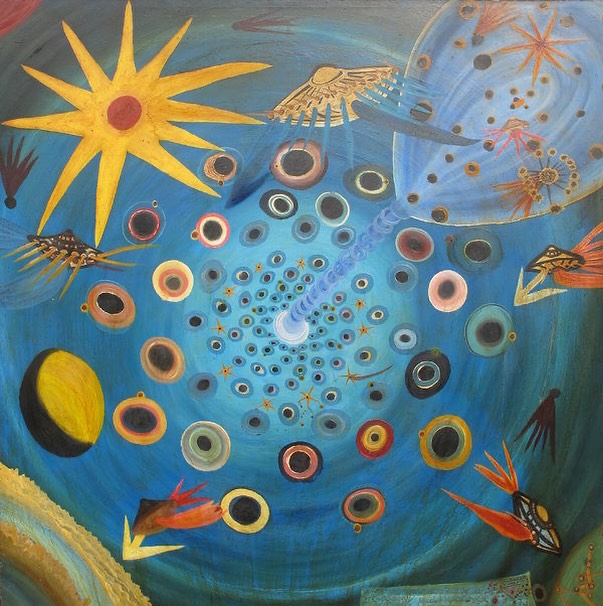
The Universe of Ionel Talpazan: a tour
The journey beyond the celestial dome, once begun, continues indefinitely. Galaxies pulsate around their suns, depicted as gigantic sunflowers or starfish. They may also spin around their own centers of gravity or cluster together, forming nests. Some planets emerge from the black void like eyes on a peacock’s tail, while others march in rhythmic ranks across an expanse of luminous blue. There is no end to these variations.
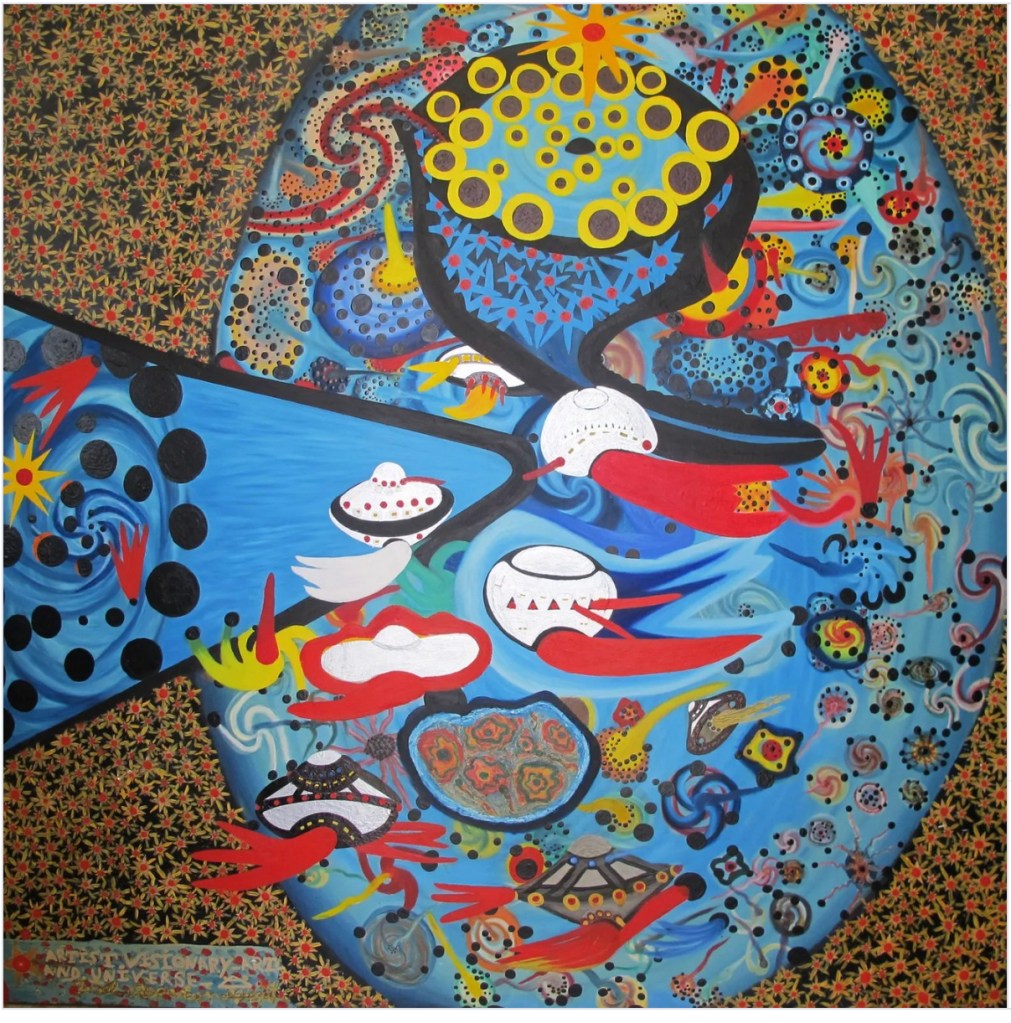
In Talpazan’s universe, galaxies are not mere clusters of matter, they are alive. They cling to each other as if organs in a body, separated by invisible membranes. One world flows into another through a gigantic funnel or penetrates its neighbor with bursts of matter. Sometimes there is a clear boundary between the two worlds; one begins where the other ends; one is black and dense, populated by large, earthy planets, while the other—rarefied and bright—contains small spheres shimmering with colors.
In this warm, amorphous cosmos, flying saucers cross galactic boundaries unimpeded. Patrolling? At times, they resemble semen seeking a chance encounter that might lead to fertilization, or plankton teeming in the oceans and sustaining life there. Viewed up close, the spaceships assume increasingly organic forms, resembling squids or hydras rather than sophisticated machines.
In a world suddenly shrinking
The world that Talpazan so joyfully explored resembled a cosmic meadow expanding continuously to reveal new patterns. The world of bureaucracy he entered, was a world of compression, closing in from all sides, a world of ever-smaller rooms and narrowing corridors, where the sign “Exit” would suddenly switch into “Not yet.” The language used there resembles the physical environment—unforgiving and stiff. The instructions preceding the multi-page application form, right from the very first sentences, block the free passage of thought—the paragraphs are dense, the sentences ramped into compact blocks. You move slowly from one comma to the next toward the nearest period, carefully chewing each word.
The long rubrics to be filled in the application form look like narrow, horizontal steps, potentially leading to an exit. This examination of conscience begins with establishing the simplest facts of one’s life: earnings, taxes, past occupations, changes of address, and all the misdeeds no matter how small. Tedious job. It will teach humility to even the most defiant. And how defiant he was! Like a piece of flint. Sparking with anger.

Misleading concept of justice
Fixated on the concept of justice and his innocence, Talpazan kept questioning the significance of the required information. It didn’t seem relevant to him whether he owned a car, or what the dates of his employment as a hot dog vendor were.
He couldn’t grasp the simple concept that his employment dates or other seemingly insignificant facts were of crucial importance for the authorities in establishing that he—in fact—existed. It is the most trivial that constitutes our existence as a social being. Without it, we remain an abstraction.
The more facts you provide, the more “real” you become, although never fully. Nevertheless, at some point the volume of data becomes sufficient enough for the case to acquire agency—enabling it to move from one phase to the next toward an unpredictable end.
No wonder a process which, at the start, calls the physical existence into question seems scary. Besides the fear of an unfavorable decision, you are haunted by the feeling that an error on an application form could cause you to disappear. This would explain why filling out the forms took such a long time. There was also another reason: a strive for accuracy. You are expected to imagine nothing else but one thing: that there exists some registry against which everything you have ever done can be verified. It is unlikely that such a registry exists; nevertheless, imagining that it does makes you search endlessly through all available documentation to establish every tiny detail: the specific day of the month, or exact amount received or paid, down to the last cent.

Have you ever?
And then there were all these questions to answer, all these boxes to check. One ought not to take the questionnaire personally—and yet, the impulse is hard to control.
“Have you ever…?” In response, a troubled conscience echoes: “Have I ever…?” and sheepishly concludes: “I’ve never even thought of such a thing, Your Honor.”
The purpose of this bizarre questionnaire might be to make the applicant aware of the fact that any question can be asked, even the most absurd, thus instead of resisting, it’s better to lapse into stupor. Once the possessed UFO artist gave up on using his common sense, he became ready to enter the final stage. Fortunately for him, he was now represented by a lawyer who believed in winning the case. As an author of a science-fiction novel, the lawyer was in a way his client’s “kindred spirit.”
Grand Finale
When the day of the “final judgment” came, Talpazan appeared in court wearing an oversized sheepskin coat and broken glasses held together with yellow tape. He told the judge how his journey as an artist began. In his youth, he was enveloped by a mysterious blue light while lying on the ground in the field after escaping the peasant family to whom his parents had sold him and for whom he had worked as a slave.
He described the beauty of the blue light emitted by the UFO, which had appeared directly above him in a rescue mission, with such intense emotion, so dramatically, that everyone in the courtroom was moved including the judge, even though she kept a straight face. The men in suits and ties who appeared in court to testify on his behalf all looked well-mannered and trustworthy. Their letters of recommendation, included in the files, all stated that Ionel Talpazan was a great American outsider artist, recognized by important cultural institutions.
The judge ruled in Talpazan’s favor but made one request: that she will get an affidavit from a psychiatrist asserting that the artist doesn’t pose a threat to public safety. In other words: asserting that he is just crazy but isn’t mad. After submitting the affidavit to the court, Talpazan was able to reapply for American citizenship. When filing the application, he seized the opportunity to fulfill his long-held desire to change his name to “da Vinci.” Once the application was approved, his dream came true—on that very day, he became both Adrian da Vinci and a U.S. citizen.
The yellow envelope
Perhaps it was this diligence—invested in making the application flawless—that transformed the final product into something strangely valuable. When the case was over, Talpazan’s friend—who had helped him prepare the application—tucked the documents away in a filing cabinet amidst other papers that also begged not to be discarded. And here they remain in the yellow envelope with his name scribbled in red. They bear witness to one person’s journey in search of freedom. Much like in the case of an ambitious artistic endeavor, all the stages leading to its successful completion have been preserved—handwritten preparatory notes, the early drafts of the application, and various letters and emails.
Epilogue
Greatly relieved after the judge’s ruling, Talpazan offered his attorney a choice of paintings. The attorney selected a wedding scene depicting a couple kissing in a garden of love, amidst flowerbeds overflowing with joy. A well-wishing friend, who served as liaison between the artist and the lawyer, asked the artist to create a series of small works. She already owned several of his paintings and did not have enough space on the walls for more.
“Time to Travel”: greetings from above
“Time to Travel,” the title for this series, sounds like an encouragement and it certainly is. It also refers to the moment when the spaceship gets ready to set a new course, or when a galaxy matures and is about to travel through space to find another.
1.
When asked to create a series of small works, Talpazan got stumped by the request. He liked his works to have a strong presence, to attract attention from afar. Besides, how do you squeeze the Universe into a small card? Ultimately, he managed.
2.
He found a way to express his vision on 5-by-7-inch cards, treating them as if they were photographic snapshots capturing fragments of a passing landscape: here’s a comet, there’s a galaxy, an explosion of matter erupting from a black hole, and here’s emerging from the void a new cosmic entity already majestic in its crimson or violet hues. Of course, there are also UFOs discreetly gliding past the fireworks of galaxies or above the rooftops of houses, the messengers of love, the carriers of blue light.
3.
Every image, no matter how sketchy, bears his name. It is not a customary signature scribbled near the edge —noticeable, yet discreet. Much like a dragon shifting its form, Talpazan’s signature undergoes transformations. The shapes of the letters and the way they are joined remain similar, yet the overall appearance differs each time. Whenever his script enters an imagined world, it seeks a place for itself within it—either traversing the landscape, or resting somewhere within it, or, at times, hiding.
4.
What does a signature that plays such an important role say? Is it the expression of a will determined to dominate reality against all odds? Or is it an attempt to lay claim to the discovered territory by naming it after oneself—the way explorers do? A surname can be given and then adopted passively; he, however, preferred to make a name for himself. This idea of a name possessing power captivated him to such an extent that he ultimately changed his own to one that radiated maximum strength: Da Vinci.
5.
To speak about the propulsion system of flying saucers, he often used metaphors drawn from the prosaic reality of his kitchen. He would heat a frying pan to observe as droplets of sunflower oil begin to swirl and then circle outward from the center to the edges. He would point to them and say: “Motion from heat. See?” His light blue is reminiscent of a gas flame on his stove. Fuchsia and magenta also have the gas-like quality of traversing from flame to liquid.
6.
The gas-like colors belong to the outer chords within the light spectrum, away from reds, oranges, and yellows of earthly fire. The spectrum continues into unknown, so the hues become dreamlike, hallucinatory, within the limit of what the markers or paints would allow.
7.
Apparently, the dark, deep blue he used in his larger paintings would not have worked in a small format—the dark blue of a sky just about to dissolve into night. Before that happens—and only for a brief instant—this blue becomes so intense that it begins to vibrate. Then it’s gone and you find yourself eye to eye with Cosmos.
8.
The crayons worked well for rendering scenes in daylight, as their color texture did not soak into the paper but remained on the surface, reflecting the light; Talpazan used them to depict the vast orb of the Sun and to render tiny details upon the Earth’s surface— a row of houses along the riverbank.
9.
An alien has arrived—a moment of stillness and hesitation ensues. Just like when a deep-sea diver in a heavy suit who asks after touching the ocean floor: “And now what?” Shortly after, a giant octopus extends its tentacles to probe the newcomer.
Curiosity! Curiosity over fear. Curiosity tinted with suspicion: Who has left traces in my backyard? Who has made a circle in my wheat field? The dogs sniff the air. The alien gently tests the ground with one of his feet. This is their first visit to our land. Not to become their last, hopefully.
10.
Perhaps those aliens see us as hollow creatures, not yet having any true substance. The waiting list for salvation must surely be long. There are many other worlds. Talpazan smiled when people talked to him about extraterrestrials. Didn’t want to hurt their feelings. He wasn’t a believer; he simply considered himself an “imaginative thinker.”
11.
The planets show one another mutual respect. A comet with an embedded heart has just flown past. As in “reverse perspective” of Byzantine icons, it’s not us looking at the higher beings, but them looking at us and knowing what we need.
12.
The universe seems quite windy today. Galaxies spin fast, like little pinwheels in the hands of children.
Was Talpazan searching for his own center of gravity by creating mandala-like circular forms? Dr. Jung would certainly have been pleased with these diligent repetitions. The cosmos certainly doesn’t radiate warmth or love, as his images suggest. Could it be that the world of galaxies seemed more friendly to him than the world of people? Perhaps not. Rather, love simply came to him “from the outside,” when he least expected it, and he accepted the healing that was offered to him “from above.”
13.
The word “technology” consists of two parts: “tékhnē” meaning method, and “logos,” meaning reason, which together signify logical methods of putting things together. He liked the term “spiritual technology.” Yes, it’s the spirit that assembles things in the most logical way!
14.
Over the centuries, various illustrations have emerged depicting extraordinary cosmic events or strange atmospheric phenomena. To Talpazan, all events were extraordinary: planets orbiting the Sun, night giving way to day, the Moon crossing the boundary between shadow and light, and the Earth—encased in a blue, glassy bubble—set in motion once and for all, hurtling along at a precisely determined speed.
15.
The Green Lady of Liberty holds a torch. The flame is alive—a tiny spark seeking communion with the Universe. Nothing in this world is perfect. For a while, it doesn’t even matter that you find yourself sleeping on the sidewalk. What counts is that you have finally arrived. It is not about being comfortable, content, or safe. You are simply free— happily exploring this grand illusion, grateful for the opportunity.
NOTES AND COMMENTS
The problem with Ionel Talpazan’s story
The problem with Ionel Talpazan’s story is that it’s too good. You can produce endless anecdotes about him. They are little sad, but mostly touching and entertaining. Many charming stories have been written about him and then recycled through various media. So, the problem is that he turned into a story one enjoys telling, and into a character portrayed by Chaplin so well—a little man with a big heart facing a hostile world.
That he wasn’t that disarming little man from Chaplin’s movies will become clear when you imagine the mighty Danube River and the mountains of Serbia on the other side—the “bloodiest border in Europe” during the 1980s. Escapees faced immense risks, including being shot by border guards or drowning. There were two ways to cross the river: swimming across where the river was wide, or at the narrow point, where the water flowing through the gorge was particularly treacherous. A statue now stands in the town of Orșova commemorating those who died attempting the crossing.
So, a man who swam across the Danube to reach freedom and then went from being homeless in New York to becoming an artist recognized by art galleries and museums and whose obituary written by an esteemed art critic appeared in the “New York Times,” this man could not have been “little.” He was short, yes, and skinny, but not little.
The important thing to know about Ionel Talpazan is that anyone who tried to help him embarked on a path to sainthood. If you wanted to prove to yourself and the world that you were compassionate and kind, the challenge was yours, but no matter how hard you tried, you were doomed to fail. Nevertheless, the kindness of your heart was not wasted—you couldn’t save the man, but you could temporarily prevent him from drowning in yet another whirlpool of the Danube.
All the gallery owners who had taken him under their wing faced the same problem. After displaying his works in themgallery, they would then find the artist outside the gallery selling his works for half of the price or less. Talpazan didn’t understand the concept of representation or dealership. He wished to represent himself his own way. On a street.
On the other hand, when he had his fits of anger and paranoia about being taken advantage of, he was in a way right: many people who knew him, entertained others with his story and enjoyed buying his art cheaply. He was that bargain everyone likes. It was easy and tempting after befriending Ionel to get what you wanted and then happily walk away.
Outsider’s art
There have been endless discussions about what the outsider’s art is or is not —a phenomenon that undoubtedly eludes precise definition—and yet, at times, it can simply be described as the creative output of individuals who, lacking access to the flow of goods and so called investment economy, begin to generate their own value. Presumably, many of Talpazan’s clients—whom he tirelessly sought out on the streets—were also outsiders, though by choice rather than by necessity. Clearly, he lived in a different world. Theirs was the world of American main stream, his was the world of American poverty.
Coda: sitting on a stone bench
At the entrance to a gloomy immigration office building at Federal Plaza, the line was long and tightly packed; everyone who reported that day for biometrics was confused and nervous, guards impatient and laud. After the fingerprints were taken and the other measurements confirmed, Talpazan and his friend who accompanied him that day, sat on a stone bench near the court, in the middle of a small square surrounded by traffic—relaxing and staring at the passersby. The ordinary urban sight seemed utterly absurd, as if these streets and buildings, the speeding cars and people were the result of some strange coincidence that had occurred in the Universe. Then, a strange reversal of scale happened—the sky started lifting above their heads making the federal courts buildings to look smaller and smaller. It opened to an enormous scale. They both sat on the stone bench for a long while reveled in the gleeful realization, “Isn’t this all insane?”
 The Painters