
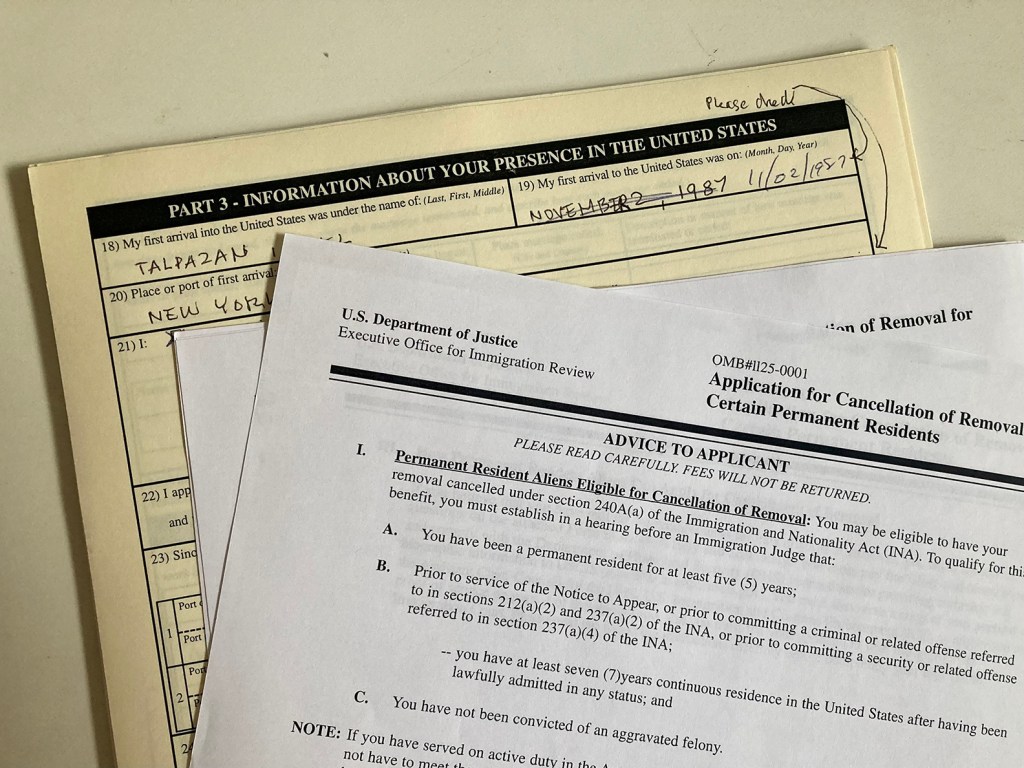

Ionel Talpazan, stateless, born in Romania.
Alien Registration Number: 936 934 715.
Date of birth: August 16, 1955.
No convictions for aggravated felonies.
First arrival in the U.S. on November 2, 1987, at JFK Airport, New York.
Self-employed artist with an income of $5,000-$6,000 per year.
Source: Request for cancellation of removal under section 240A of the Immigration and Nationality Act.
__________________________
ALIEN
AI Overview: The full meaning of “alien” encompasses being foreign/unfamiliar (not belonging to one’s country, group, or nature), a foreigner/immigrant (a person from another country without citizenship), or, popularly, an extraterrestrial (a being from outer space). Legally, an alien is a person not a citizen or national of the country where they reside, while as a verb, to alienate means to estrange or transfer property.
.
.
.
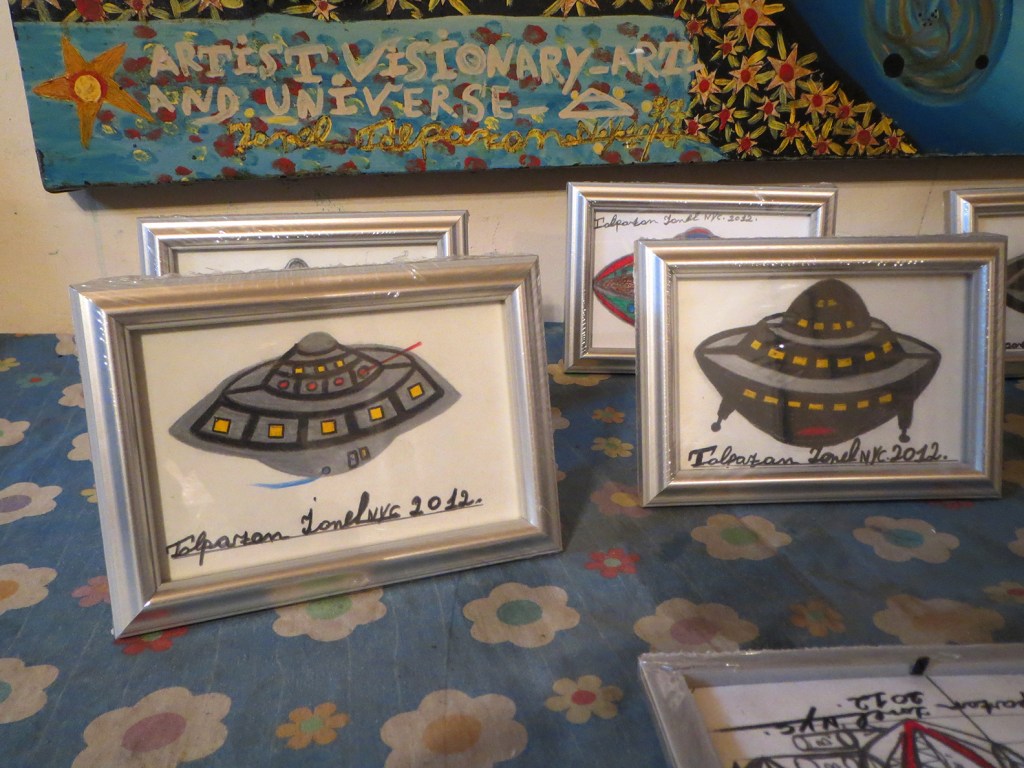
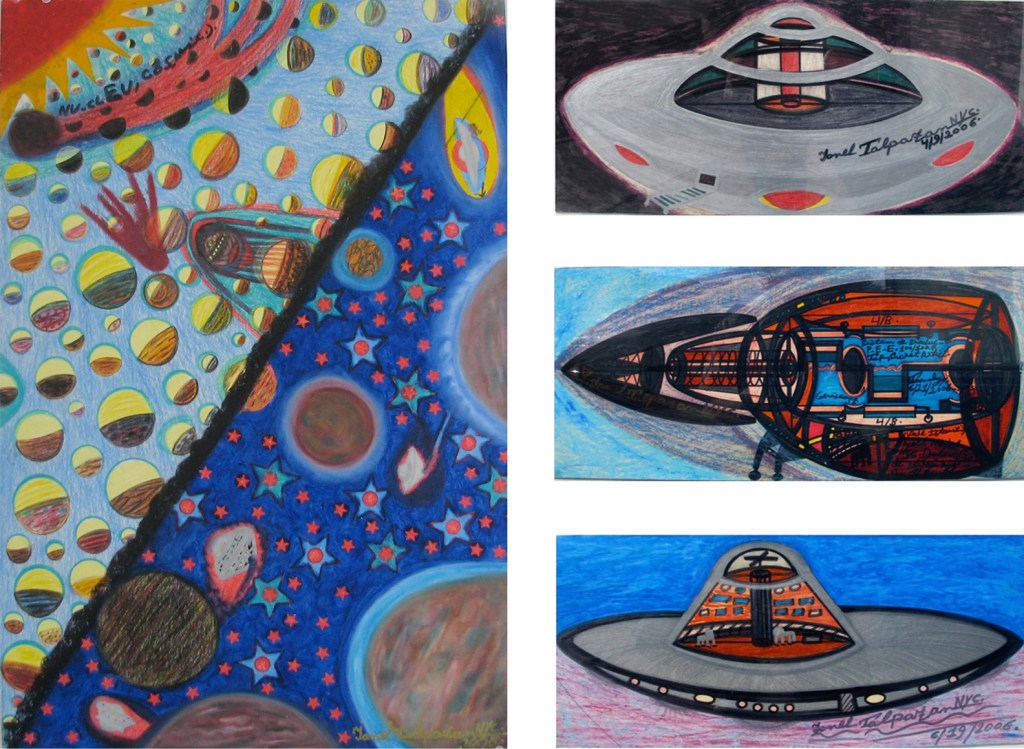
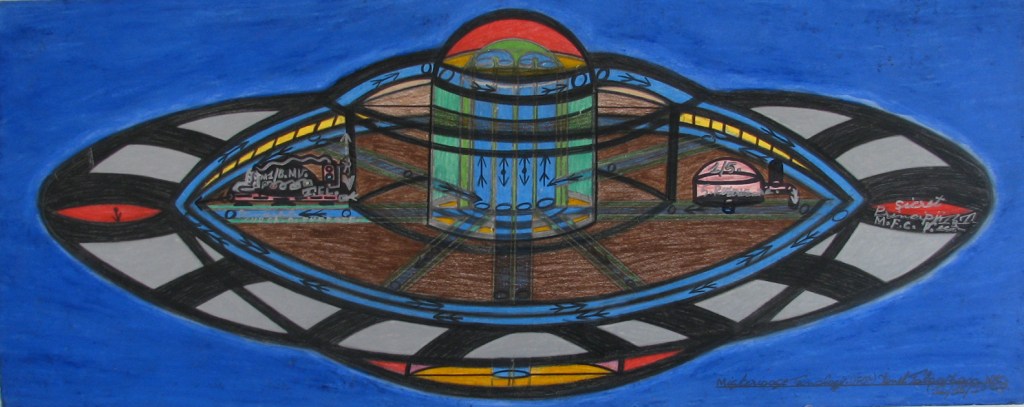
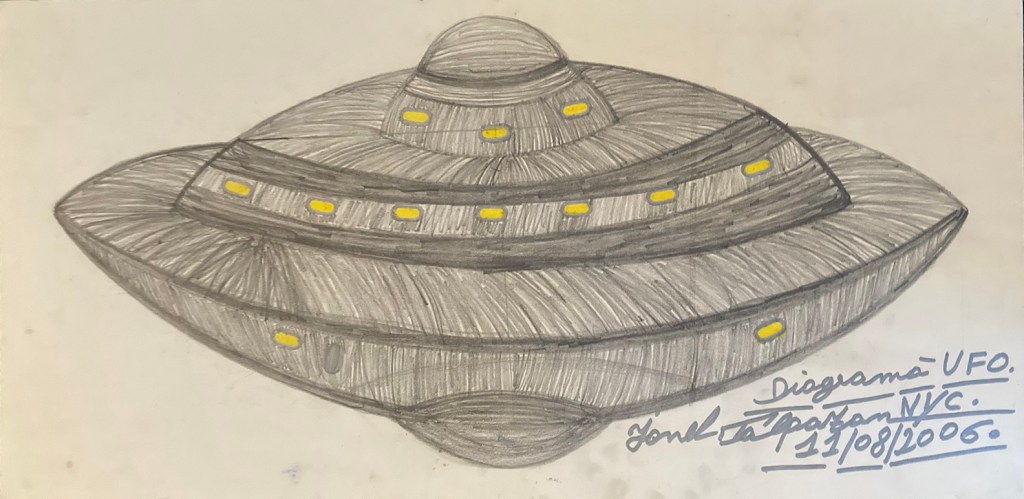
Ionel Talpazan, known as the “Master UFO Painter,” was recognized by the New York art establishment and represented by leading art dealers specialized in outsider art.
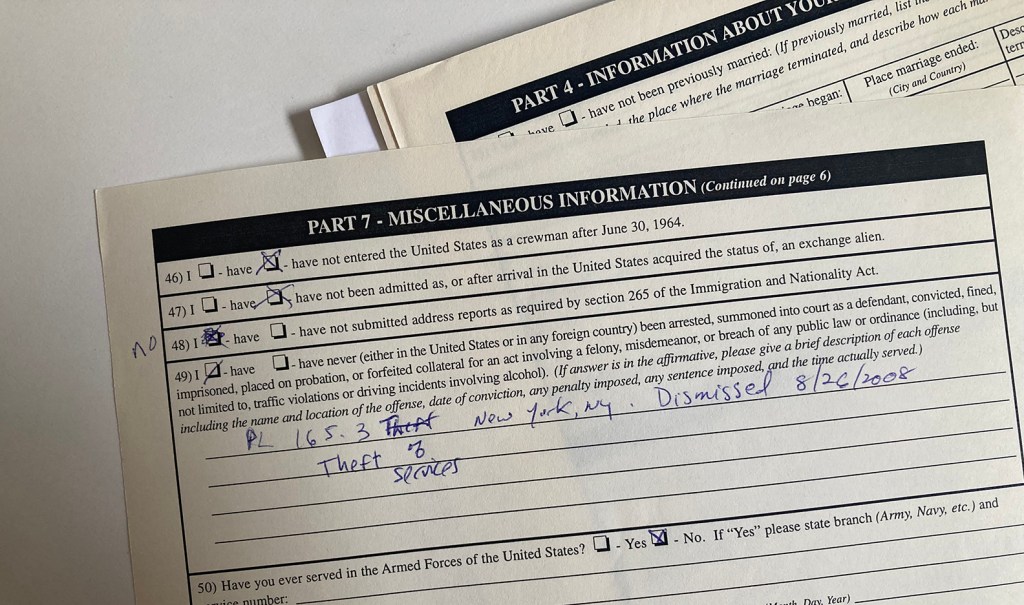
He unintentionally violated the law by voting in federal election, assuming that as a permanent resident he was supposed to vote. What he did was a serious offense punishable by deportation, so when on his application for American citizenship he stated that he had voted, the deportation charges were immediately brought against him by the immigration authorities.
The only way for Talpazan to avoid deportation was to prove to the judge that he had made some significant contributions to the society.
How do you prove in court that you are a good artist? “Good luck to you,” as the judge routinely says after concluding the master hearing.
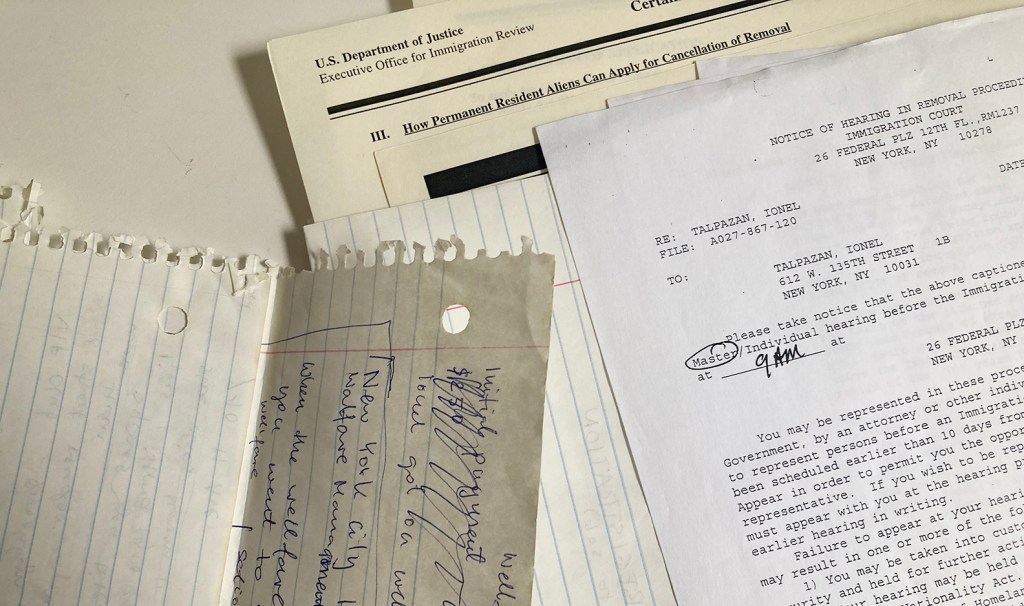
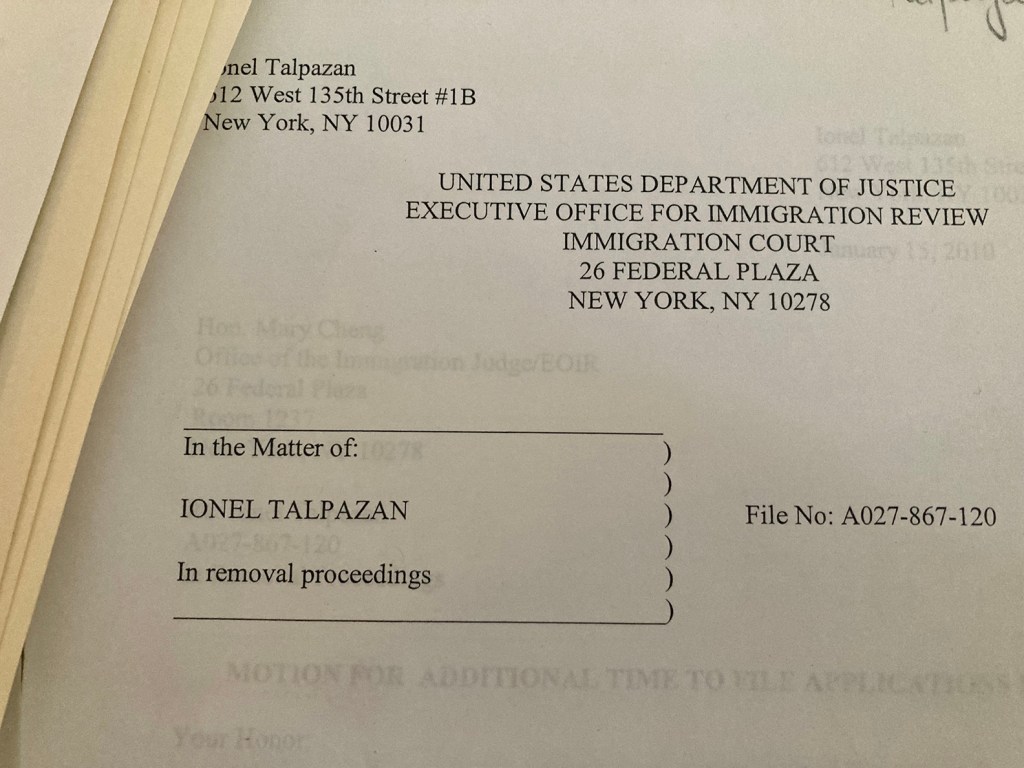
MOTION FOR ADDITIONAL TIME TO FILE APPLICATIONS FOR RELIEF
Your Honor:
Upon the attached declaration of lonel Talpazan and the other documents attached hereto, I respectfully request that the filing deadlines in my removal case be suspended, and that on March 10, 2010, the date of my next Master Calendar hearing, they be reset. Thank you very much for your consideration of this request.
Sincerely,
Ionel Talpazan
.
In the Matter of:
IONEL TALPAZAN
In removal proceedings
File No: A027-867-120
DECLARATION OF RESPONDENT
IONEL TALPAZAN declares under penalties of perjury that the following is true and correct:
1. My name is lonel Talpazan. I am the respondent in the above-captioned proceedings.
2. I make this declaration in support of my request that this Court grant me additional time to submit any and all applications for relief from removal.
3. 1 first entered the United States as a refugee on or about November 2, 1987, and I obtained my lawful permanent residence as of that date.
4. I was placed into removal proceedings before this Court in 2009.
5. I am a self-employed artist, with a low income, and am unable to afford private counsel to represent me in my removal proceedings.
6. 1was formerly represented in these proceedings by The Law Office of David H. Faux, acting pro bono.
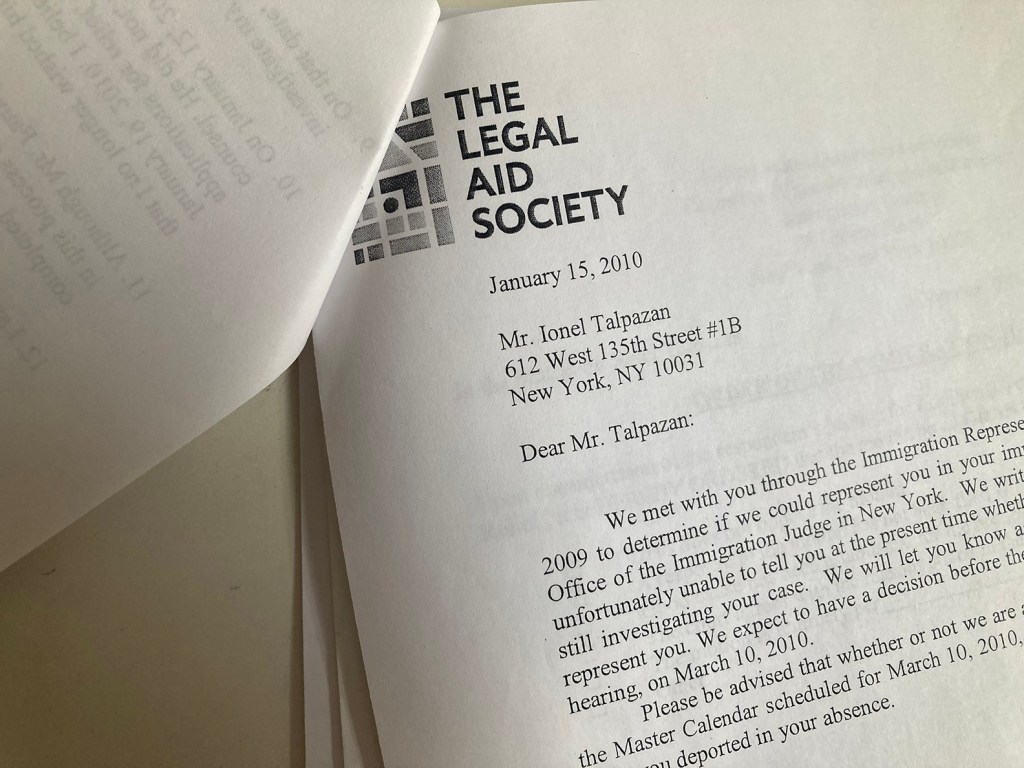
7. 1 am hopeful that The Legal Aid Society will decide to represent me, but I don’t yet know if they will be able to do so. My understanding is that if they do decide to represent me, they will be able to help me complete the forms on which work has already been done, and also to help me submit well-organized documents in support of my applications for relief.
8. I believe I would suffer great prejudice were I not given an extension of time to file my applications for relief and any supporting documents that were due on or about January 19, 2010. I would lose my lengthy legal residence in this country and be deported either to Rumania, where 1 still fear harm, or to another country where I would be a stranger.
9. For these reasons, I respectfully request that this Court suspend the current deadline for the filing of my applications for relief, and set new deadlines when I appear before the Court for my next Master calendar on March 10, 2010. By that date I hope to have obtained new counsel who will be able to agree to a new filing deadline.
10. I sincerely apologize to the court and to the government for any inconvenience that may have been caused by my inability to timely file the relief applications, and/or by this request for an extension.
11. This declaration has been read to me in the Rumanian language and I understand everything in it and declare that the contents are true and correct. 17 7 A cif 7
January 15, 2010
Mr. Ionel Talpazan
612 West 135th Street #1B
New York, NY 10031
With his slight appearance and thick Romanian accent, Talpazan didn’t strike pro bono lawyers as someone they could present as a “special asset.” The lawyers saw no chance of winning his case and pressured him to choose the country to which he wanted to be deported. He was stateless and had free choice. He chose Italy.
But one lawyer, the author of a science fiction novel called “Red Cheer,” believed Talpazan’s case could be won. When the day of the “final judgment” came, Ionel appeared in court wearing an oversized sheepskin coat and broken glasses held together with yellow tape. He told the judge how his journey as an artist began. In his youth, he was enveloped by a mysterious blue light while lying in a ditch on a field after escaping the peasant family to whom his parents had sold him and for whom he had worked as a slave.
He described the beauty of the blue light with such intense emotion, so dramatically, that everyone in the courtroom was moved: his lawyer, the art dealers and gallerists who appeared as witnesses, and the judge, even though she kept a straight face. She had in his file the letters of recommendation, which stated that Ionel was a great American outsider artist, recognized by important cultural institutions. The men in suits and ties who appeared in court to testify on his behalf all looked well-mannered and competent.
The judge ruled in Ionel’s favor and he was able to reapply for American citizenship. He seized the opportunity to fulfill his long-held desire to change his name to “da Vinci.” His dream came true, and on the same day, he became both: Adrian da Vinci and an American citizen.
THE UNIVERSE OF IONEL TALPAZAN: A TOUR
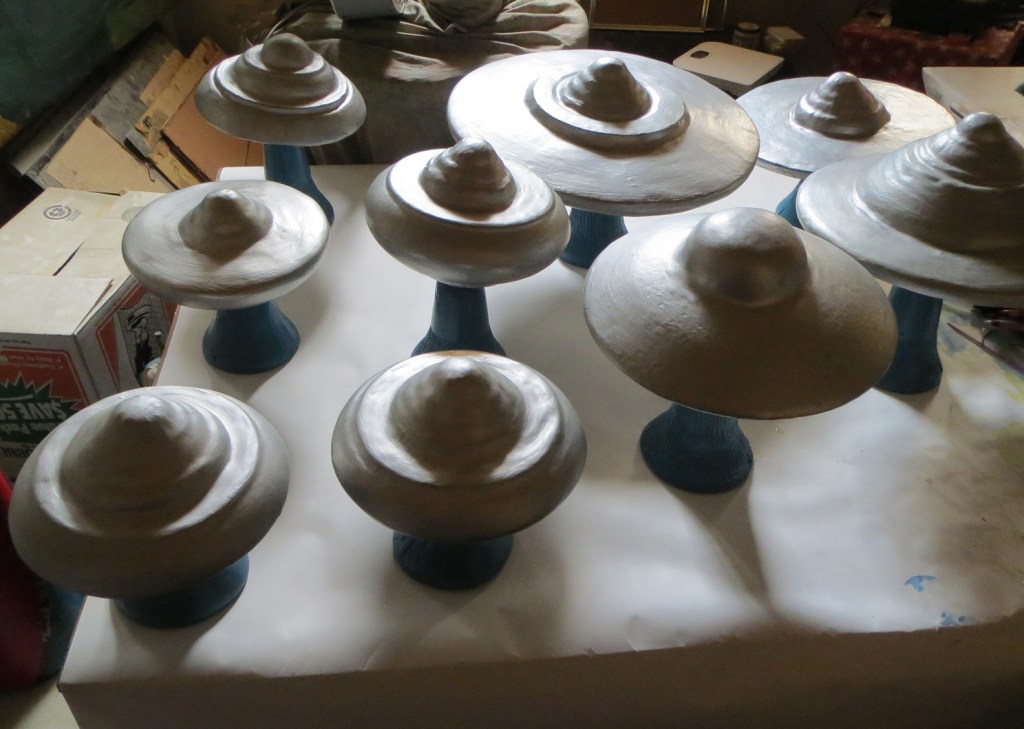
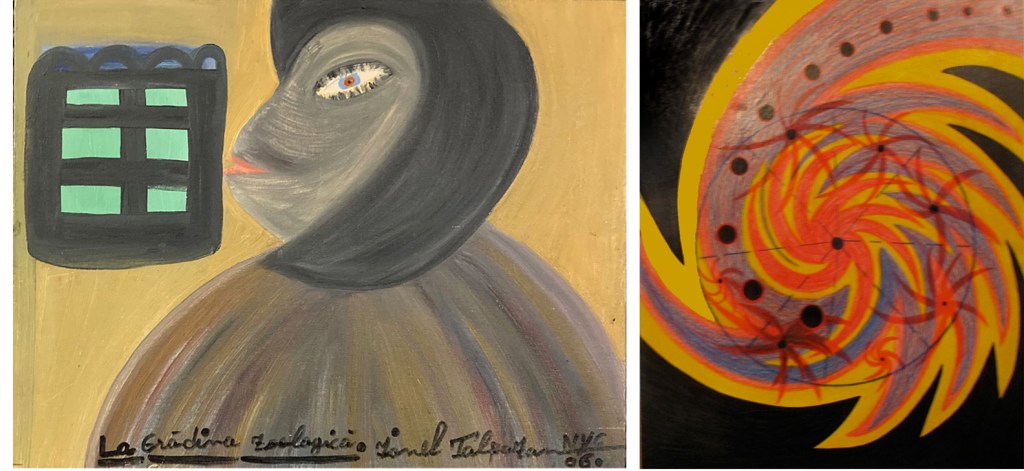
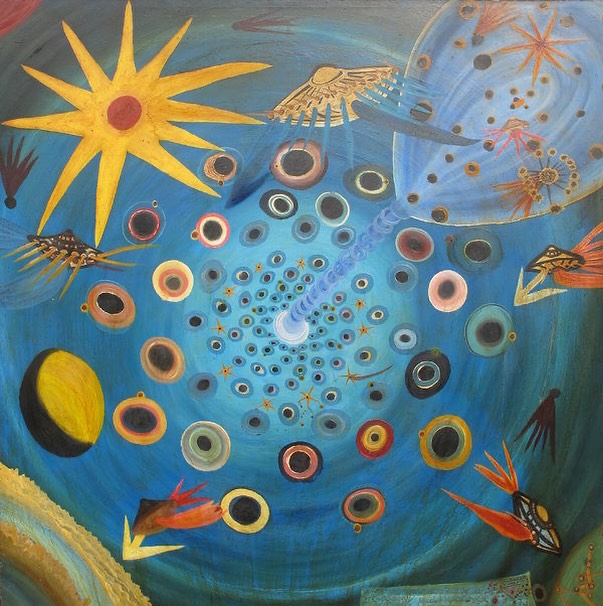
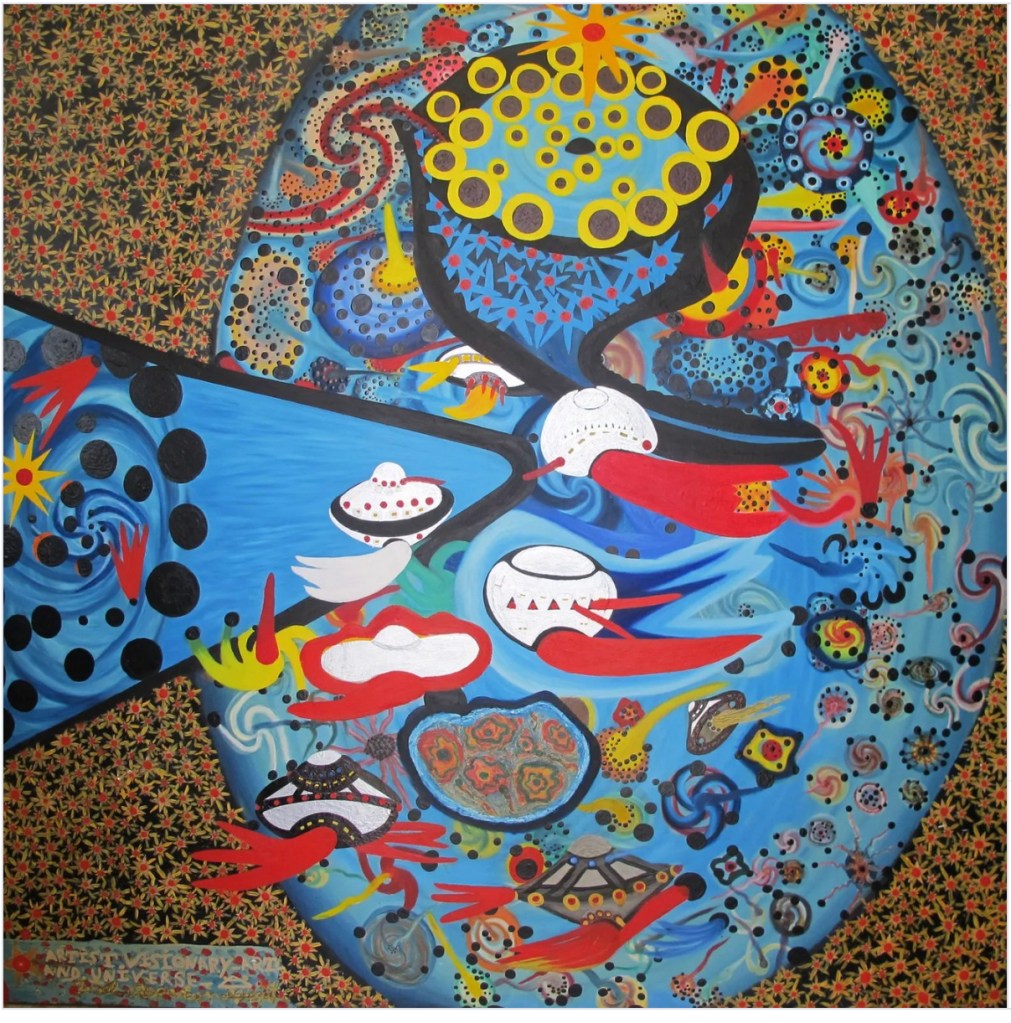
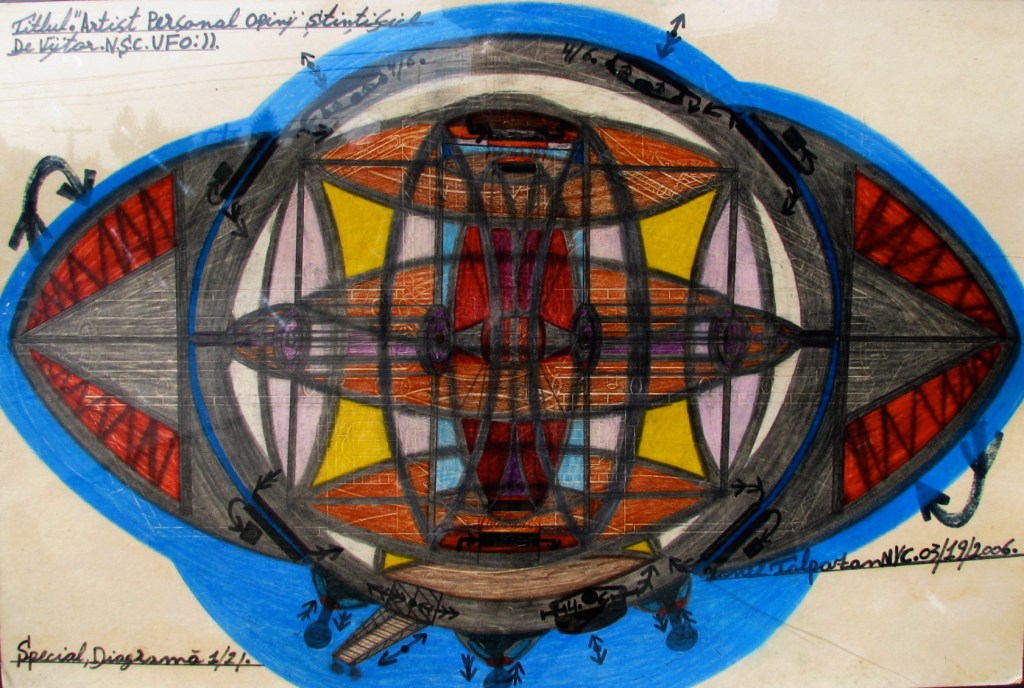
In Talpazan’s universe, galaxies are not mere clusters of matter, they are alive. In this warm, amorphous cosmos, flying saucers move freely from world to world, almost like the messengers sent by the highest cosmic being. When viewed up close, they take on increasingly organic forms, resembling squids or hydras rather than sophisticated machinery presented on Talpazan’s diagrammatic style drawings.
———————————-
“TIME TO TRAVEL”: GREETINGS FROM ABOVE
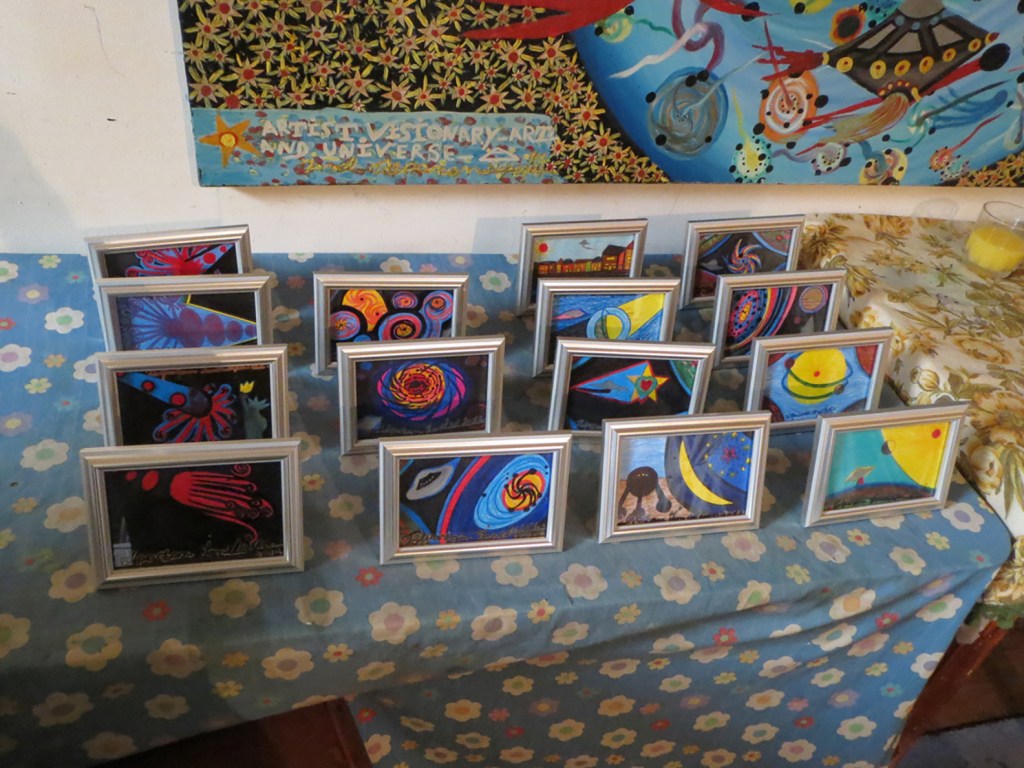
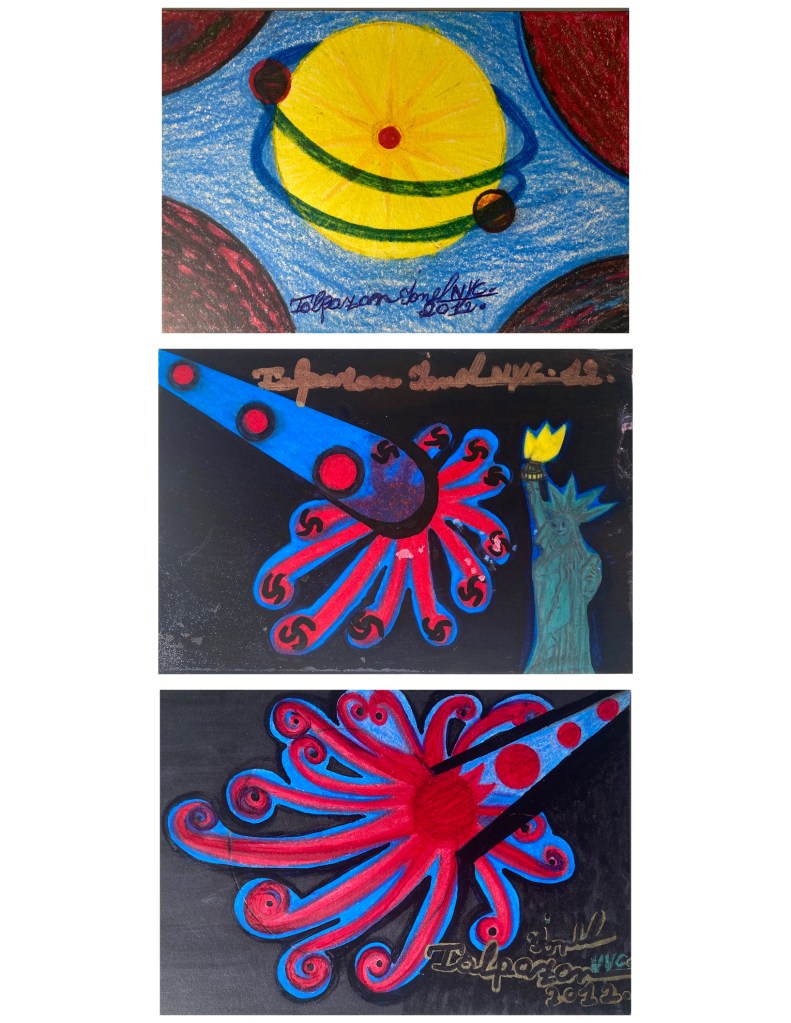
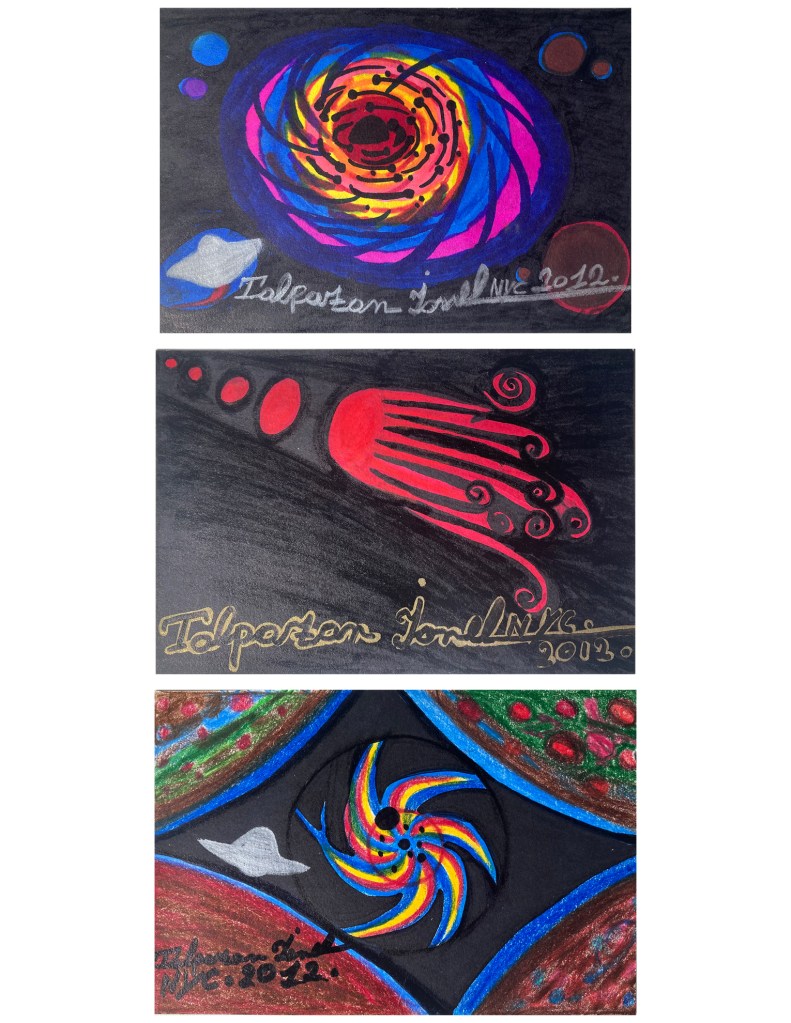
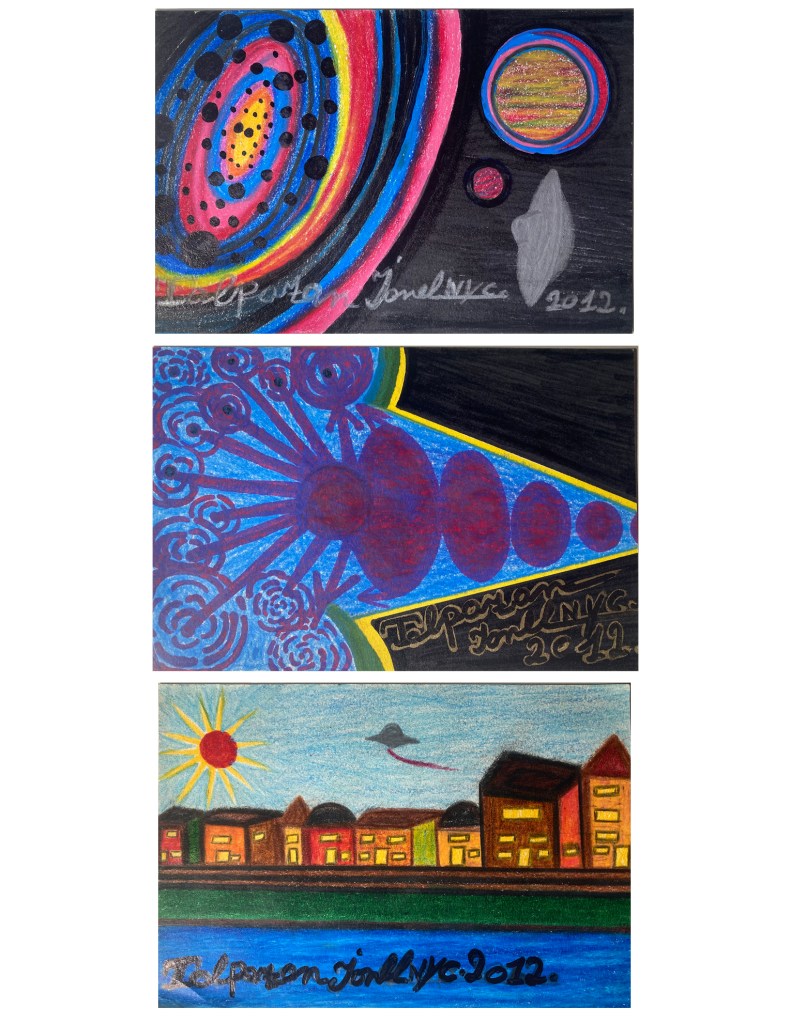
Ionel liked his works to have a strong presence, to attract attention from afar. When asked to create a series of small works, initially, not knowing how to approach the task, Ionel got frustrated. Ultimately, however, he found a way to express his vision on 5 x 7 inch cards, creating something akin to snapshots, similar to those taken during travels, which capture only fragments of the landscape in motion: here’s a comet, there’s a galaxy, an explosion of matter erupting from a black hole, and here’s a newly born cosmic entity emerging from a tunnel, already majestic in its crimson or violet hues. Of course, there are also UFOs discreetly gliding past the fireworks of galaxies or above the rooftops of houses, the messengers of love, the carriers of blue light.
“Time to Travel” seems to be a great title for this series, as if it encourages you to leave behind your daily troubles and embark on the journey of a lifetime.


IN THE LABYRINTH
Ironically, the “Time to Travel” series was created after a visit to a world completely different from the friendly cosmos – a world that could be described as a vast labyrinth.
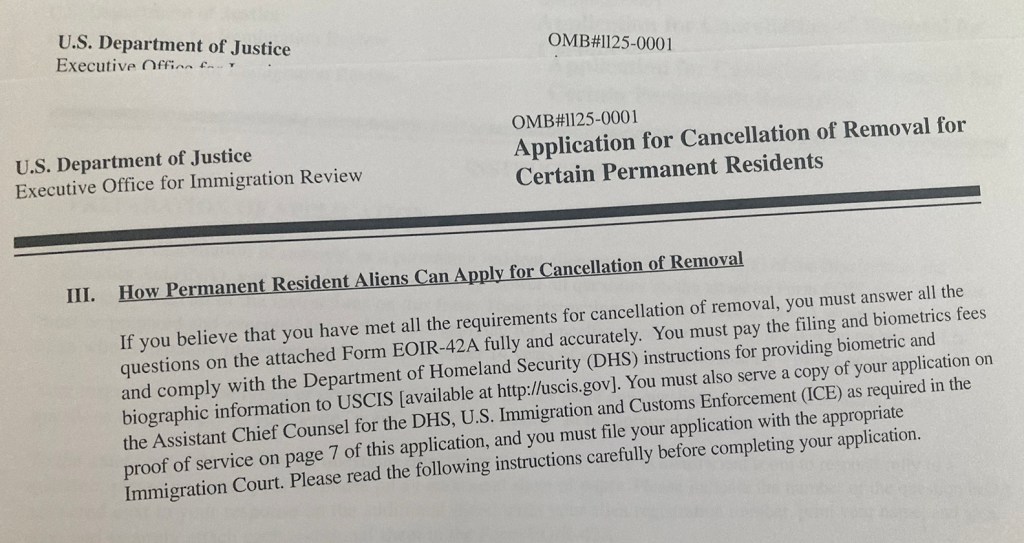
The long rubrics to be filled in the multi-page application form look like narrow, horizontal steps, potentially leading to an exit. None of them can be skipped; detailed information must be provided about income, taxes, all the jobs held in the past, all changes of address, and all the misdeeds no matter how small.
This Examination of Conscience consists mainly of numbers and “yes” or “no” answers. Tedious job. It will teach humility to even the most defiant.
Let us now travel through two different worlds
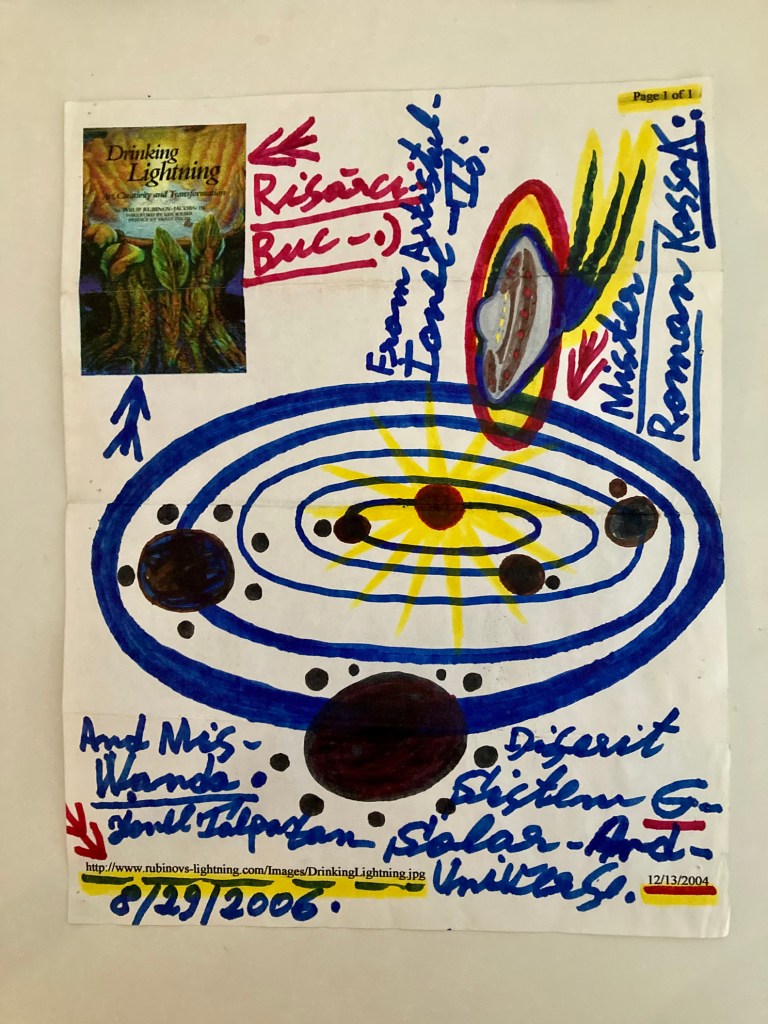
The world that Talpazan so joyfully explored resembled a carpet unfolding before his feet, a cosmic meadow studded with stars in ever-changing patterns, a world expanding into infinite space. The world of bureaucracy, into which he stepped in, was a world of compression, closing in from all sides, a world of ever-smaller rooms and narrowing corridors, where the sign “Exit” would suddenly switch into “Not yet.” The language used there resembles the physical environment—unforgiving and stiff. The written instructions block the free passage of thought; the paragraphs are dense; the sentences ramped into compact blocks. You move slowly from one comma to the next toward the nearest period, carefully chewing each word.
NOTES AND COMMENTS
The word “technology” consists of two parts: tékhnē meaning method, and logos, meaning reason, which together signify logical methods of putting things together. This most basic understanding of the term best explains Talpazan’s fascination with technology – that is, with cause-and-effect processes and the interrelationship of elements. His talent lay in combining elements into a coherent whole, which was evident both in his inquiries into the functioning of flying objects and also in the “logic of methods” he employed in creating his compositions. He displayed incredible ingenuity in developing compositional schemes that allowed for the creation of countless variations, each of which made sense and was pleasing to the eye.
Technology! Talpazan liked the term. “Spiritual technology,” actually. Yes, it’s the spirit that assembles things in the most logical way.

======
The cosmos certainly doesn’t radiate warmth or love, as Ionel’s paintings suggest. Could it be that the world of galaxies seemed more friendly to him than the world of people? Hopefully not. Rather, love simply came to him “from the outside,” when he least expected it, and he accepted the healing that was offered to him “from above.”
======
Thousands of stars, intricately painted in arabesque patterns or in endless rows, attest to Talpazan’s ability to concentrate – a quality expected of an icon painter / writer, which he was in a somewhat eccentric way, striving hard to convey his unity with a higher being.
=====
Was Talpazan searching for his own center of gravity by creating mandala like circular forms? Dr. Jung would certainly have been pleased with these diligent repetitions.
======
We all know that angels have wings but how big are the wings, and how do they grow? Are they white, or do they shimmer with iridescent colors like mother-of-pearl? What do they really look like? These are questions that every painter who believed in what the Gospel proclaims must have asked. “Hypothetical appearance” is a well-known problem in visual arts; in the Christian tradition it wasn’t enough to ask the followers to take the Church Fathers at their word, the word had to be painted, somehow. Therefore, Talpazan’s investigations into the construction and appearance of flying saucers seem to fit into the painter’s old challenge of imagining “what does something that doesn’t exist look like?”
.
 The Painters